Mapping Neural Network Models for Fraud Pattern Detection in Multi-Jurisdiction Poker Transaction Logs

Online poker platforms process millions of transactions daily across borders, which creates opportunities for fraud schemes that exploit differences in regulatory oversight, and neural network models have emerged as tools that map these complex patterns to flag suspicious activity before losses accumulate. Researchers have adapted convolutional and recurrent architectures to analyze sequences of bets, deposits, and withdrawals while accounting for varying legal frameworks that govern each jurisdiction.
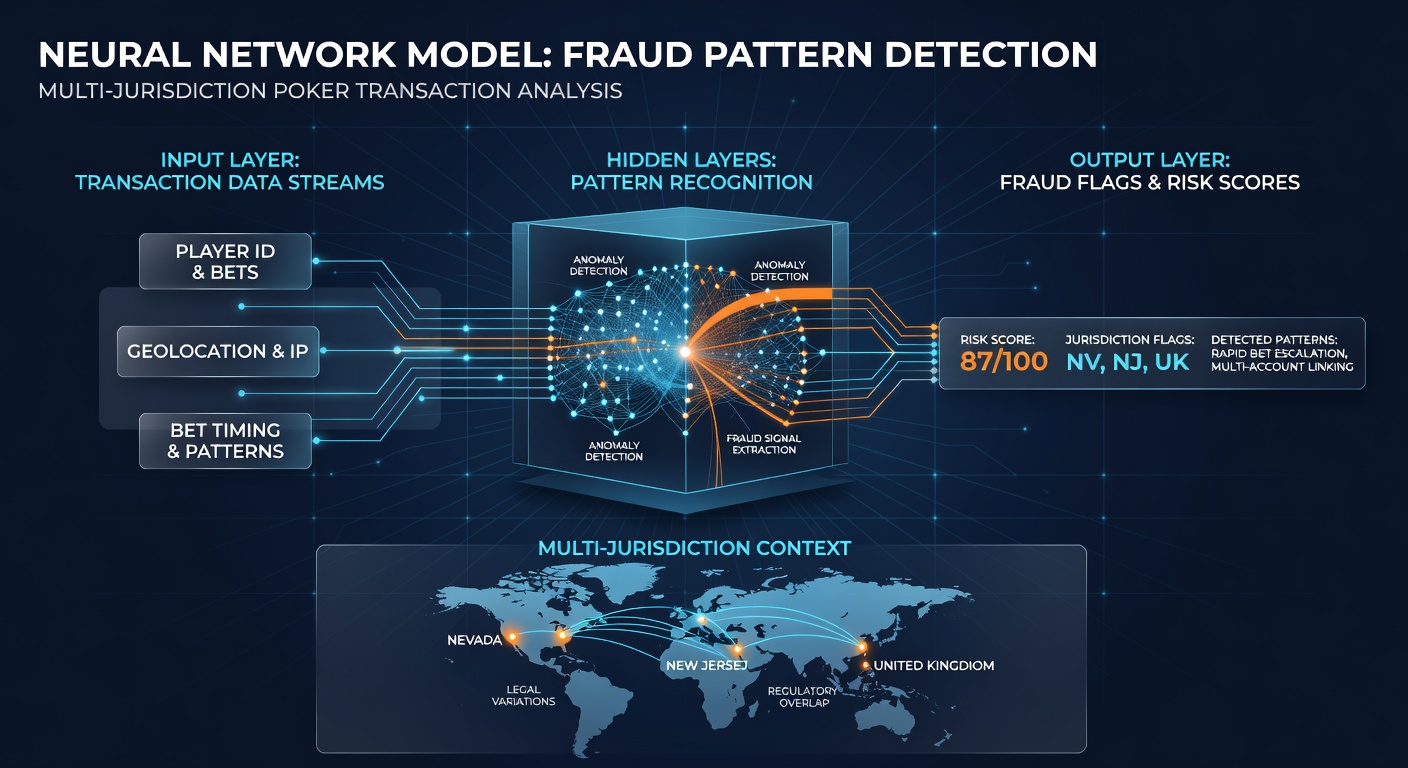
Data from regulated markets shows transaction volumes in poker networks grew steadily through early 2026, with multi-jurisdiction operators reporting increased attempts at money laundering via rapid chip transfers between accounts registered in different regions. Neural networks process these logs by converting raw transaction fields into vector representations that capture timing anomalies, amount clustering, and cross-border routing behaviors that traditional rule-based systems often miss.
Core Components of Neural Network Architectures
Models typically combine long short-term memory layers with graph neural networks to represent player accounts as nodes and transfers as edges, allowing the system to detect coordinated activity across seemingly unrelated profiles. Training datasets incorporate anonymized logs from platforms operating under licenses in North America, Europe, and Asia-Pacific regions, where feature engineering focuses on variables such as session duration, bet sizing relative to account history, and velocity of fund movements between poker rooms.
One study revealed that hybrid models achieved higher precision in identifying mule accounts when they integrated jurisdiction-specific compliance flags as additional input channels, whereas single-jurisdiction training produced more false positives when applied to logs from operators spanning multiple regulatory environments.
Cross-Border Data Challenges and Standardization Efforts
Multi-jurisdiction logs present inconsistencies in timestamp formats, currency conversions, and reporting thresholds that complicate model training, yet practitioners address these gaps through normalization pipelines that align records to a common schema before feeding them into the network. As of June 2026 regulatory updates in several North American and Australian markets require operators to maintain standardized audit trails, which has improved the availability of comparable datasets for fraud detection research.
Experts note that federated learning approaches allow models to train across siloed datasets without direct data sharing, preserving privacy requirements while still capturing patterns that span borders. This method has proven effective when one jurisdiction imposes stricter data localization rules than another, enabling collaborative detection without violating local statutes.
Implementation Examples Across Regulated Markets
Operators in Nevada have deployed graph-based neural networks that trace chip dumping schemes involving accounts registered under different state licenses, and similar architectures appear in Australian systems monitoring tournament satellite entries for unusual funding sources. Reports from the Nevada Gaming Control Board indicate that integration of these models reduced confirmed fraud cases by measurable margins during 2025 testing phases, although exact percentages vary by operator size and transaction volume.
Academic researchers at institutions focused on computational finance have published findings showing that attention mechanisms within transformer variants improve detection of slow-burn collusion patterns where fraudsters gradually build transaction histories to evade velocity checks. These patterns often involve multiple jurisdictions because perpetrators route funds through intermediaries in regions with lighter real-time monitoring requirements.
Evaluation Metrics and Ongoing Refinement
Performance evaluation relies on precision-recall curves rather than simple accuracy scores because fraud events remain rare compared with legitimate play, and models must maintain low false positive rates to avoid disrupting normal poker traffic. Continuous retraining incorporates new transaction types introduced by platform updates, such as cryptocurrency buy-ins that gained traction in certain licensed markets by mid-2026.
Those who've studied deployment timelines observe that initial model accuracy improves markedly once jurisdiction metadata becomes a stable input feature, while periodic audits ensure the network does not develop biases against particular regions or player demographics that could affect regulatory compliance.
Conclusion
Mapping neural network models onto multi-jurisdiction poker transaction logs continues to evolve as operators and regulators align on data standards that support more robust pattern recognition. Advances in federated architectures and attention-based sequence modeling provide concrete pathways for identifying fraud that crosses borders, and ongoing refinements tied to 2026 regulatory changes suggest further gains in detection capability without compromising operational flow.